
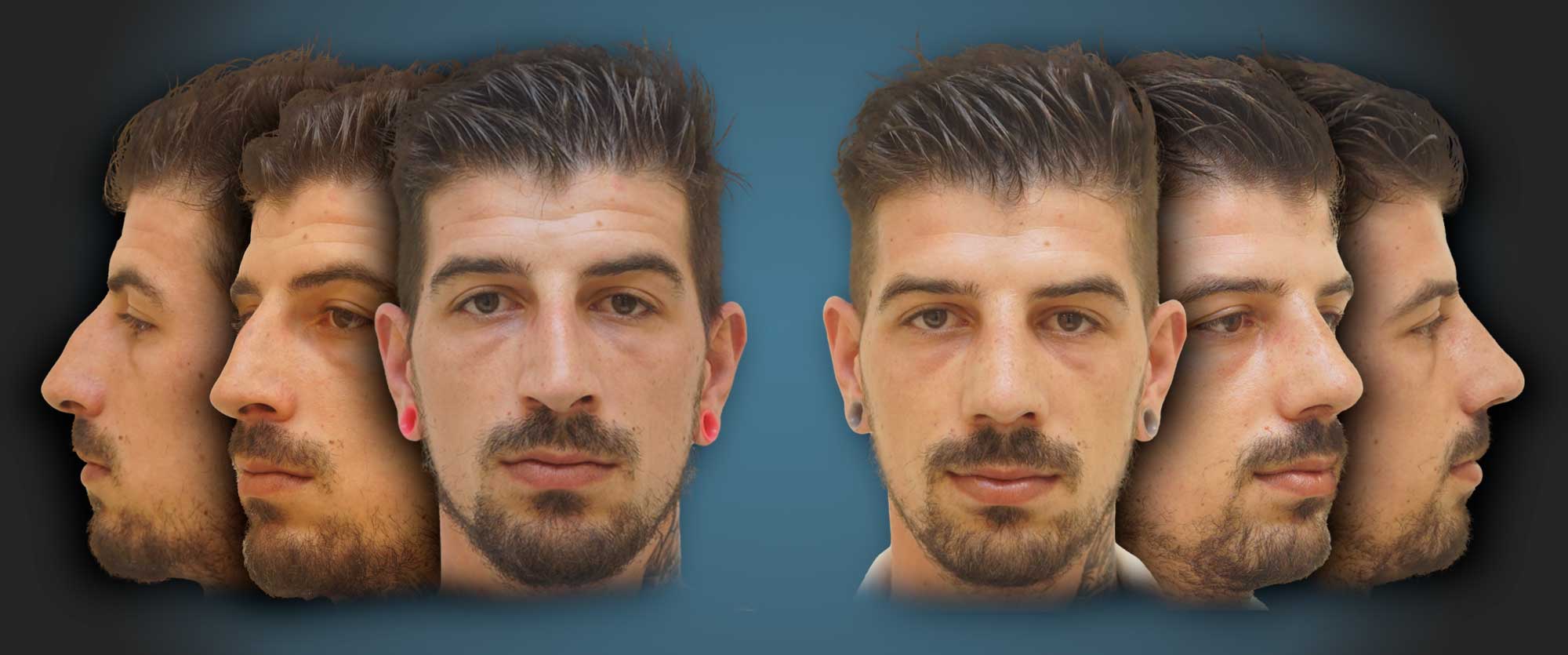
“A broken nose is not just a crooked nose: it is a nose that has lost its structure, and that is what has to be given back.”
What is post-traumatic rhinoplasty
Post-traumatic rhinoplasty is the surgery that corrects the after-effects of a blow to the nose: a fracture that healed crooked, a collapsed bridge, a deviated septum or a tip that lost its support. It is also called reconstructive rhinoplasty, rhinoplasty after a fracture or broken nose surgery. Unlike a cosmetic rhinoplasty, it does not start from a healthy nose: it starts from bone and cartilage that broke, healed as best they could and often stopped holding the nose up and letting air through. That is why its aim is twofold, form and function, and why it almost always means rebuilding, not just reshaping.
The blow can come from an accident, a fall, a fight or sport. It makes no difference whether it was three months ago or fifteen years ago: a nose that was left misshapen after a fracture can be operated on, and in most cases breathing is restored along with the profile.
I am a plastic, aesthetic and reconstructive surgeon specialising in nasal surgery, and I operate in Madrid, Spain.
| Anaesthesia | General. |
|---|---|
| Duration | 3 to 4 hours. |
| Hospital stay | Usually none; occasionally one night. |
| Scar | Inside the nose; in an open approach, a small incision on the columella that is barely visible. |
| Recovery | Splint for 10 days; social life after a week; contact sport after two months. |
| Result | The profile within weeks; the final result at twelve months. |
| Price | 10,000 to 20,000 €. |
| Where | Madrid, at HLA Moncloa and Vithas Aravaca. |
Broken nose: what to do right after the injury and when to operate
What is done about a broken nose depends on how much time has passed:
- The first few hours. If it bleeds heavily and will not stop, if you cannot breathe through your nose or if you feel a soft lump inside, go to A&E: a haematoma of the septum that is not drained destroys the cartilage within days.
- The first ten to fourteen days. When the bones have shifted, they can still be repositioned by hand, without surgery, with a closed reduction. After that the bone starts to set in the position it was left in and no longer moves.
- From then on. If the nose healed crooked or collapsed, or if you breathe badly, the answer is post-traumatic rhinoplasty. It is done once the swelling has gone and the bone has finished healing.
There is no hurry except in the first two weeks. Many of my patients come years after the injury, when they are tired of breathing through their mouth or of seeing a crooked nose in photographs. A minimum of 3 months has to pass before planning corrective surgery, to allow the swelling to settle.
If you are still within the first two weeks, we will see you to attempt a repositioning and reduce the need for a larger operation.
Nasal fracture damage this surgery corrects
Every blow leaves a different mark. The ones I see most often:
- Crooked or deviated nose: the nasal pyramid healed off the axis of the face.
- Collapsed bridge or saddle nose: the septum lost height and the bridge sinks inwards, as in this case with breathing difficulty.
- Irregularities and bony callus: steps, bumps or a hump that was not there before the injury.
- Deviated septum and turbinates: the most common reason you have breathed badly ever since.
- Nasal valve collapse: the nose closes when you breathe in.
- Drooping or unsupported tip: when the septum stopped holding it up.
- Septal perforation: a hole in the wall between the nostrils, with crusting, whistling and bleeding.
And what cannot be seen: mouth breathing, snoring, recurrent sinusitis and poor sleep. When the press asked me about an athlete’s repeated fractures, I put it this way: in the long term there can be chronic breathing problems, recurrent sinusitis, sleep disturbance and obstructive apnoea. A broken nose that is not corrected is not just a cosmetic problem.
If your nose closes when you breathe in, read nasal valve insufficiency: why you breathe badly.
The first consultation and the CT scan
Before deciding anything I need to know what broke and how it healed. I examine the nose outside and inside, check how you breathe through each nostril and look at photographs from before the injury if you have them. For a traumatised nose I request a preoperative CT scan: it shows the bone, the septum and the sinuses, and it is what lets me plan the right strategy instead of discovering it in theatre. With that I can tell you what can be corrected, what needs rebuilding and whether we will need cartilage from elsewhere.
How the surgery is done: open, with grafts and with support
Post-traumatic rhinoplasty is structural surgery. Every piece that healed badly has to be freed, the bones repositioned with osteotomies, the septum straightened and a stable support built again. That is why I almost always do it open, with a small incision on the columella: I need to see the whole structure to rebuild it. The scar sits hidden between the nostrils and after a few months is barely noticeable.
To work on the bone I use my usual technique, ultrasonic rhinoplasty, which allows previously fractured bones to be repositioned precisely and with less bruising.
The grafts. A broken nose almost always needs cartilage to recover the support it lost. If the septum still has enough cartilage, I take it from there. When the septum is broken, depleted or was already used in a previous operation, I take a small amount of cartilage from the patient’s own rib, through an incision of a few centimetres, and with it I rebuild the bridge and the support of the tip. This is what makes it possible to restore breathing in cases where the nose collapsed, as in this case of a bridge that collapsed after a blow, rebuilt with a rib graft; and it is the same technique I use on noses that have already been operated on several times.
In the same operation I correct the functional side: the deviated septum, the valve and the turbinates. A broken nose is repaired completely or not at all.
Septal perforation after an injury
Septal perforation is a separate and very important chapter of reconstructive septorhinoplasty. A blow, an illness, an infection or substance use can open a hole in the septum that causes crusting, whistling on breathing and bleeding, and that over time sinks the bridge. The aim is to close the perforation and restore or preserve the support of the nose, using cartilage and tissue grafts from the patient. The smaller it is, the easier it is to close: it is worth having it seen early.
Athletes: when to operate on a nose that keeps breaking
Boxing, rugby, football, martial arts. Some patients have broken their nose two, three or four times, and each fracture leaves the septum more crooked and the bone more fragile. With them the question is not just how to operate but when: if you are going to keep competing, the usual approach is to rebuild when you can protect the nose for at least two months and, in a contact sport, to talk about a face guard when you return. What does not pay is leaving it until the end of your sporting career: every blow to a badly healed nose is paid for in breathing.
Recovery after surgery
There is no pain on waking: the discomfort of the first few hours is controlled with oral painkillers. You will wear a splint on the bridge for ten days and, if we have worked on the septum, silicone tubes that let you breathe. Bruising under the eyes is somewhat greater than in a cosmetic rhinoplasty, because bones that have already broken once have to be moved; it clears in one to two weeks. Social life after a week, gentle exercise after a month, contact sport after two months. If I took cartilage from the rib you will feel some discomfort in your side for a few days. Breathing improves as soon as the internal swelling goes down; the final profile takes twelve months. Day-by-day care is explained in recovery after nose surgery.
Risks of post-traumatic rhinoplasty
They are those of any rhinoplasty: bleeding, infection, bruising and swelling, temporary changes in sensation, some irregularity and the possibility that the result is not what was expected. With a traumatised nose two things have to be added. First, the surgery starts from scarred tissue and bone that healed badly: the risk of small irregularities and of needing a touch-up is somewhat higher than with a nose that never broke. Second, the risks specific to the rib graft: a scar of a few centimetres on the chest, discomfort at the donor site for a few days and, very rarely, warping of the graft over time; the risk of injuring the pleura is exceptional and is monitored during surgery. What reduces all these risks most is a well-read scan, honest planning and good aftercare. There is always the possibility of minor touch-ups under local anaesthesia or larger ones in theatre.
When this is not the right surgery
- If the injury was less than two weeks ago and the bones are displaced: the first step is a closed reduction, not a rhinoplasty.
- If your nose has never been broken and what you want to change is its shape: that is a rhinoplasty.
- If you have already had nose surgery and the problem comes from that operation and not from an injury: that is a revision rhinoplasty.
- If you only breathe badly, with no deformity: functional surgery may be enough; I explain it in nasal valve insufficiency.
- If you are going to keep taking blows over the next two months, we wait.
Post-traumatic rhinoplasty before and after
Two cases with a name and a timescale: a bridge that collapsed after a blow, rebuilt with rib cartilage, at four months, and a saddle nose with severe deviation, at nine. The rest of my nose cases are in my rhinoplasty gallery, each with its technique and timescale.
Post-traumatic rhinoplasty in Madrid, Spain
I operate in Madrid at HLA Universitario Moncloa and Vithas Aravaca. As well as operating, I run an intensive rhinoplasty course with live surgery for other surgeons.
If you broke your nose and it has been left crooked, collapsed or blocked, come for a consultation: the first step is knowing what broke and what needs rebuilding.
Frequently asked questions about post-traumatic rhinoplasty
Can a broken nose be operated on years after the injury?
Yes. There is no upper time limit: healed bone and cartilage can be freed, repositioned and rebuilt even if the injury was twenty years ago. The only thing that changes with the years is that the septum is usually more deviated and more grafts are needed.
How long do I have to wait after a fracture to have surgery?
A minimum of 3 months.
What is the difference between reducing a fracture and post-traumatic rhinoplasty?
Fracture reduction is done in the first few days: the bones are repositioned by hand, without cuts, before they set. Post-traumatic rhinoplasty is done once they have set in the wrong position: it is a full operation that re-breaks with precision, repositions, straightens the septum and rebuilds the support with grafts.
Is a rib graft always needed?
Is it harder than a standard rhinoplasty?
Yes. It is performed on scarred tissue, bone that healed badly and a septum that often no longer provides support. That is why planning with a CT scan and experience in reconstruction matter more here than in any other rhinoplasty.
Will I be able to go back to contact sport?
Yes, from two months on, and with a face guard if the sport allows it. A well-rebuilt nose holds up like a nose that never broke; what does not hold up well is a badly healed nose.
What happens if I do not have my broken nose operated on?
It depends on how it was left. If it is only cosmetic, nothing beyond seeing it crooked. If the septum was left deviated, you will usually breathe worse and worse, snore, have recurrent sinusitis and sleep badly; and every new blow to a badly healed nose makes it worse.
How much does post-traumatic rhinoplasty cost in Madrid?
Between 10,000 and 20,000 euros. The price includes the consultation and surgical plan, theatre, team and anaesthesia, follow-up visits and postoperative care. Financing is available up to 10,000 €. The figures in my price guide are updated for 2026.
Is it covered by insurance or the accident insurer?
It depends on the type of policy you hold. Cover can often be claimed from your insurer.