
A few days ago I gave an interview to the Spanish newspaper AS where I talked about something I see every week in my practice and that very few people know how to identify: nasal valve insufficiency. I want to expand here on what I told there, because a short interview makes it impossible to properly explain a problem that affects thousands of people and that many carry with them for years without knowing it has a name, a diagnosis and a solution. If you’re interested in the journalistic version, you can read the interview published in AS. What follows is the complete explanation, from my consultation.
Let me put it simply so it is clear: nasal valve insufficiency is the collapse of the narrowest area of the nose when you inhale forcefully. When the cartilages that support that area are weak or have been weakened, the nose physically closes when you take in air. And it often has nothing to do with a deviated septum, which is the first thing people think of. It is something else, in a different part of the nose, and it is examined in a different way.
Breathing poorly through your nose is not an inconvenience, it is a health problem. And it almost never has to do with physical fitness, or tiredness, or with the idea that “you’ve always been like this”. It has a specific anatomical cause, identifiable and, in most cases, surgically correctable.
Dr. Marco Romeo · Plastic surgeon in Madrid
The problem is that the healthcare system barely addresses it and patients end up normalising the symptom to the point of not even consulting about it. I have operated on athletes who trained at a high level convinced they had a lung problem. I have treated patients who had spent a decade sleeping badly without knowing why. And I have re-operated on people who went to another clinic looking for a more beautiful nose and came out with a nose that breathed worse than before.
I’m going to talk about all of that here.
What nasal valve insufficiency actually is
The nasal valve is the narrowest area of the entire upper respiratory tract. It is located in the middle third of the nose, where the lateral cartilage meets the septum. It works like a small dynamic funnel: when you take in air, that structure must remain rigid so that the airflow enters without obstruction.
If the cartilages that support it are weak, displaced, have aged or have been weakened by previous surgery, the valve collapses inwards when you inhale forcefully. The air no longer enters. The nose, physically, closes.
This is what we call nasal valve insufficiency. And although the name may sound technical, the symptoms are very recognisable if you know what to look for.
Symptoms: how to tell if you have it using the mirror test
In the AS interview I explained a very simple test that anyone can do in front of a mirror. I repeat it here because it is the first step to understanding whether what is happening to you has this origin:
Other symptoms that usually accompany this problem, based on my experience in consultation:
- A sensation of suffocation when exercising, especially when running or going uphill.
- Needing to breathe through your mouth during sport even if you are in good physical shape.
- Snoring or waking up with a dry mouth.
- The feeling that one side of the nose “lets no air in”, especially when lying down.
- Habitual use of nasal strips or sprays to be able to sleep or train.
Many patients who come to my practice describe this as “being out of shape”. And it is not. It is a mechanical problem of their nose. No matter how much you train, if the structure closes when you inhale forcefully, the air is not going to come in.
Why almost nobody has diagnosed it before
This is probably the part I am most interested in explaining, because it is where things go most wrong.
Nasal valve insufficiency is a functional diagnosis. That means it doesn’t show well on an X-ray or a conventional CT scan. It is diagnosed by observing the nose in motion, evaluating the collapse on inhalation and exploring the cartilaginous structure with the hands. It requires a specialist who knows what they are looking at.
In the public healthcare system, when a patient consults because they “can’t breathe well”, the usual thing is to focus on what can be easily seen: a deviated septum, hypertrophy of the turbinates, allergic rhinitis. All of those are real and treatable conditions. But if the origin of the problem lies in the nasal valve and no one explores it, the patient can have septum surgery, take antihistamines for years or use sprays daily without the main symptom improving.
That is why I see so many frustrated patients in my practice. It is not that they haven’t been treated: it is that no one has looked at the right problem.
To save you time, I’m summarising in a table the main differences between the three problems that are most often confused with one another. It is what I mentally review when a patient walks through the door describing their symptoms:
| Symptom | Nasal valve insufficiency | Deviated septum | Allergic rhinitis |
|---|---|---|---|
| Gets worse with intense exercise | Yes | Sometimes | No |
| The nasal wing sinks when inhaling | Yes | No | No |
| Itching, sneezing, watery eyes | No | No | Yes |
| Clearly improves with nasal strips | Yes | Sometimes | No |
| Gets worse in certain positions | Sometimes | Yes | No |
Important: many patients have more than one of these problems at the same time. That is why an honest evaluation must rule out or confirm each component separately, not stick with the first one that appears.
The two stories I see most often in consultation
When someone comes to my practice with this problem, they almost always fit one of these two profiles.
The person who has lived with it their whole lifeIt’s someone who has always breathed so-so. They never linked it to a specific problem. They learned to sleep in a certain way, to breathe through their mouth when exercising, to accept that “this is just how I am”. When I explain what is happening to them, they usually have a very similar reaction: relief. Finally someone is putting a name to something they had been noticing for years.In these cases, the origin is usually a congenital structural defect: laterally weak cartilages, thin nasal wings, or a septum deviated since childhood that has conditioned the rest of the structure.
The person who breathed well until they had surgeryThese are patients who went to a clinic looking to improve the aesthetics of their nose, and came out with a nose that breathes worse than the one they had.
This happens when a rhinoplasty prioritises aesthetics over function. To achieve a finer dorsum or a more refined tip, the surgeon removed supporting cartilage without adequately reinforcing the structure. What the AS interview makes clear and what I defend at every congress I attend: a rhinoplasty that worsens breathing is not a well-done rhinoplasty, however beautiful it may look.
When these patients come to see me, the approach is no longer aesthetic: it is reconstructive.
How it is actually solved
The good news is that nasal valve insufficiency has a surgical solution, and the results are very reliable when surgery is planned properly.
The most common technique is what we call functional rhinoplasty with reinforcement grafts. Broadly speaking, it consists of placing small fragments of the patient’s own cartilage — generally from the septum, or if none is available, from the ear or rib — to reinforce the valve area and prevent it from collapsing on breathing. There are several types of grafts depending on the specific problem: spreader grafts, batten grafts, alar rim grafts. The choice depends on the patient and on which exact part of the valve is failing.
In my case, practically all of these surgeries I plan as ultrasonic rhinoplasty, a technique that allows me to work the bone with much greater precision and that drastically reduces bruising and postoperative inflammation. It is a tool that has changed the way nasal surgery is done in recent years, and which I consider the standard for any patient who can afford it.
The important thing is to understand that this is not about “narrowing the septum” or “removing what’s extra”. It is about providing support where there is none. The philosophy of modern nasal surgery is to preserve and reinforce, not to resect.
And when there's an aesthetic component as well
Many patients who come for a functional problem also have an aesthetic concern. And vice versa: patients who come for aesthetic reasons in whom, when we examine them, we discover a functional problem they were not aware of.
In the way I work, form and function are not separated. It makes no sense to refine a dorsum if doing so is going to collapse breathing. And it makes no sense to reinforce a valve without taking the opportunity to refine what aesthetically concerns the patient, if they wish. Modern nasal surgery allows both things to be done in the same procedure, with results that are both beautiful and functional.
When we talk about secondary rhinoplasty — that is, the revision surgery of a nose that has already been operated on — this principle becomes even more important, because they tend to be cases where the balance between form and function is clearly broken and has to be rebuilt from scratch.
What I want you to take away from this
If you’ve read this far in the article, you’ve probably recognised yourself in something. Perhaps in the mirror test. Perhaps in the feeling of not breathing well when exercising. Perhaps in the frustration of having had surgery and not improving as you expected.
What I would like you to take away from this are three ideas:
The first: breathing poorly through your nose is not normal. It is not something you have to accept as part of your life. It has a specific cause and, in very many cases, a solution.
The second: the diagnosis requires a specialist who knows how to examine the nasal valve. If you have spent years on treatments that don’t work, probably no one has looked at where the real problem lies.
And the third, especially if you are considering an aesthetic rhinoplasty: never accept a surgery where the priority is only the aesthetic result. A beautiful nose that breathes worse is not a surgical success. It is a future problem that sooner or later someone will have to repair.
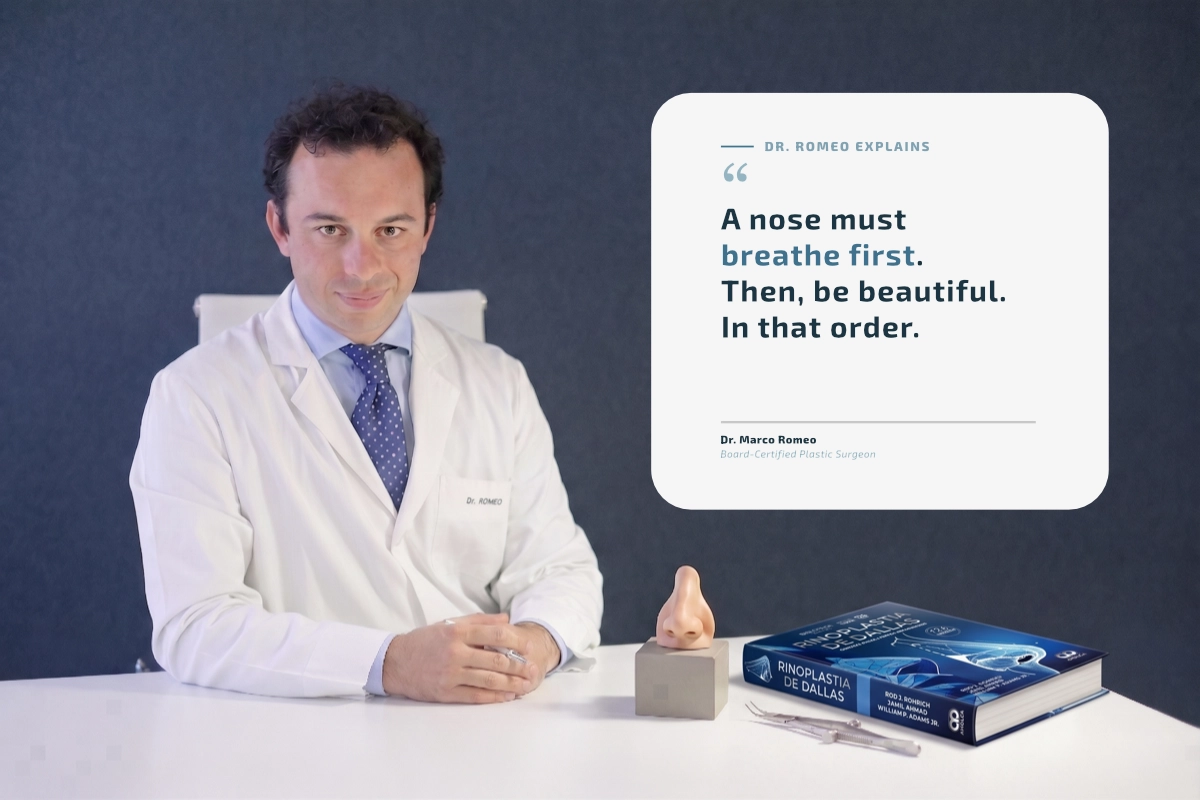
I have been teaching this philosophy to other surgeons for years through the Interactive Aesthetic Fellowship, the training programme I direct. And I repeat it in every consultation: the nose has to breathe first. Then, be beautiful. In that order.
Do you think you may have nasal valve insufficiency?
If you’ve recognised yourself in the symptoms in this article, or if you’ve had surgery and notice that you breathe worse than before, the first step is an honest evaluation. I’ll be glad to help.
Frequently asked questions about nasal valve insufficiency
Is a deviated septum the same as nasal valve insufficiency?
No. They are two different problems, although they can coexist. A deviated septum is a displacement of the inner wall that separates the two nasal passages. Nasal valve insufficiency is the collapse of the narrowest area of the nose on inhalation. A person can have one, the other or both. That’s why it’s so important that a specialist evaluates both separately: correcting only the septum when the main problem is the valve does not solve the symptom.
Can it be treated without surgery?
Not in a definitive way. There are temporary solutions such as nasal dilator strips or certain intranasal devices that help keep the valve open while in use. They work as external support. They are useful occasionally, but they don’t address the cause. The only lasting solution for true nasal valve insufficiency is to surgically reinforce the cartilaginous structure..
Does the surgery change the shape of the nose?
It depends on how it is planned. Purely functional surgery, with well-placed reinforcement grafts, can be performed without significantly altering the external appearance. If the patient also wants to improve the aesthetic aspect, a combined functional and aesthetic rhinoplasty is planned in the same surgical procedure. The decision is the patient’s, and it should be made with clear information about both possibilities.
How long does recovery from functional rhinoplasty take?
In my practice, the usual timeline with ultrasonic technique is as follows: you will wear a small, light splint for about 7 days. At 7–10 days most patients can return to office work and social life, thanks to the fact that bruising is minimal or non-existent. From the first month, gentle exertion is allowed; from week 5, moderate exercise progressively. For contact sports or activities with a risk of impact to the nose, it is best to wait at least two months. The definitive and stable result is appreciated between 6 and 12 months after surgery. Each patient has their own pace, and the exact timelines are adjusted during postoperative follow-up.
I had nose surgery years ago and since then I breathe worse. Is there a solution?
Yes, in most cases. It’s one of the most frequent reasons I see patients in my practice. When a previous rhinoplasty has weakened the structure, the solution involves a revision surgery — secondary rhinoplasty — in which valve support is rebuilt with cartilaginous grafts. These are more delicate surgeries than a first rhinoplasty, but the results are very reliable when properly planned.
How do I distinguish whether what's happening to me is allergy or a valve problem?
The clearest difference is the pattern. Allergy produces congestion, itching, sneezing and usually varies with seasons, environments or certain triggers. Nasal valve insufficiency is a mechanical collapse that appears especially when inhaling forcefully, during exercise, when lying down or when doing the mirror test. Many patients have both at the same time, and that’s why an evaluation that rules out or confirms each component separately is important.
Is the surgery covered by public healthcare?
When there is a clearly functional component — significant breathing difficulty, sleep disturbances, exercise intolerance — part of the treatment may have public coverage. In practice, waiting lists and the depth of the functional approach vary widely by region and centre. That’s why many patients end up choosing private healthcare, where they can choose surgeon, technique and planning. The important thing, in any case, is not to normalise the symptom and to seek specialist evaluation.