
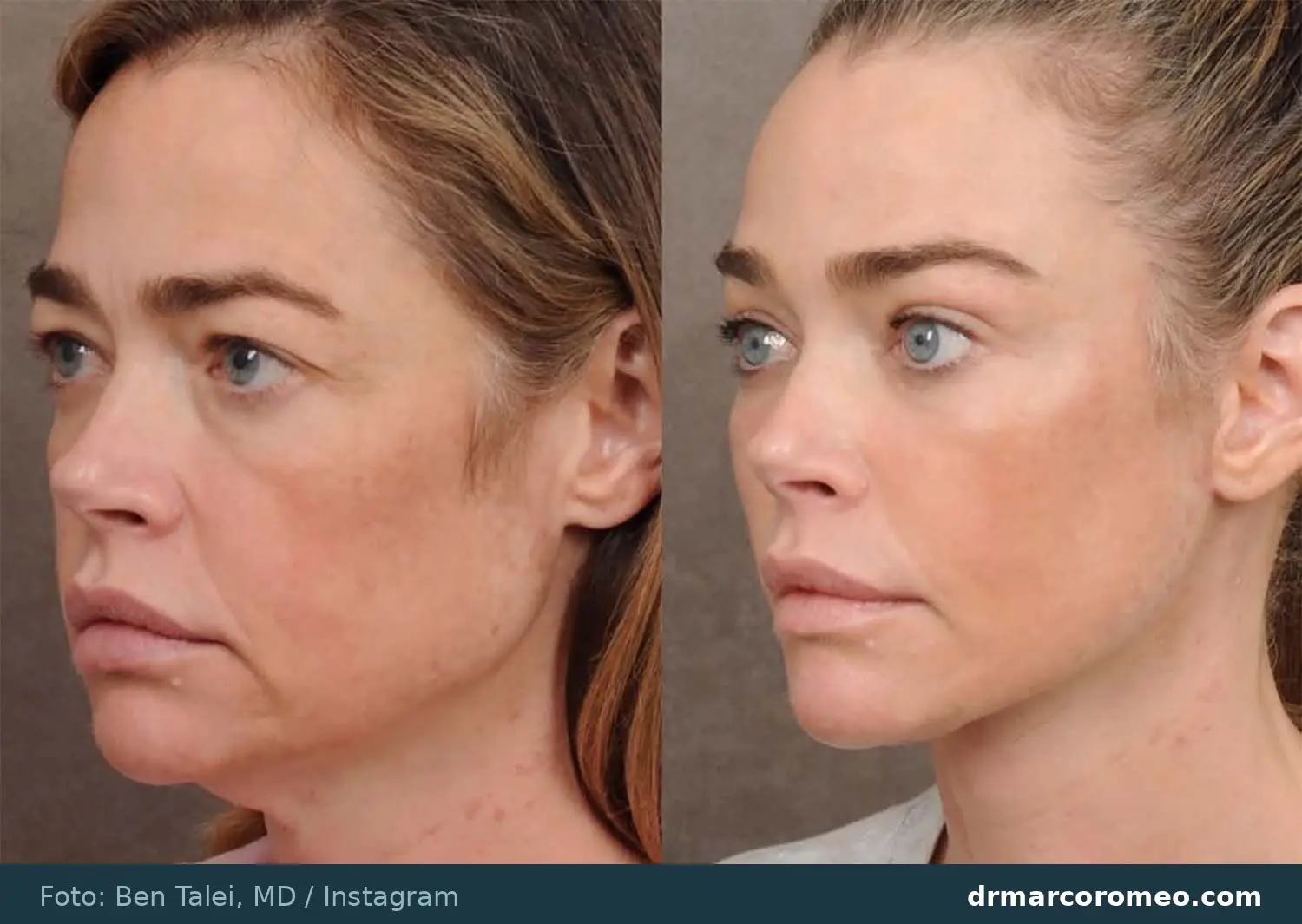
Denise Richards has just publicly shared her experience with a Deep Plane facelift, performed by Dr. Ben Talei, one of the world’s leading references in this technique. Before her, Kris Jenner did the same. And what interests me is not the name, but the tone: neither of them has treated it as a drama or a confession. They have talked about it for what it is, a personal wellbeing decision.
As a facial surgeon specialised in Deep Plane, I have been waiting for this moment for years.
What Has Really Changed
For decades, facial surgery was trapped in a double stigma. On one hand, the results of old techniques — which were limited to pulling the skin — left visibly “operated” faces. On the other, when a public figure admitted to having a facelift, the narrative was almost always sensationalist: shocking photos, scandalous headlines, morbid curiosity.
That created an association I still encounter in my practice: facelift equals artificial, equals secret, equals something better left unsaid.
What Richards and Jenner are doing is breaking that association. They are not “confessing” anything. They are showing that a modern facelift is part of self-care, just like exercise or nutrition. And they are doing so by showing results that confirm what I defend every day: absolute naturalness.
Why Old Facelifts Did Leave a "Wind-Swept Look" (and Today's Don't)
To understand why that stigma existed, we need to understand what was being done wrong. Traditional facelifts worked on the most superficial layer: the skin. It was pulled laterally to smooth wrinkles and disguise sagging. The problem is that skin is elastic, and when subjected to excessive tension two things happen: in the short term, the face takes on that tight appearance we all recognise; in the medium term, the skin gives way again because the real cause of sagging has not been addressed.
The real cause is the descent of the deep structures: the SMAS (the muscular system that supports the face), the fat compartments and the ligaments that anchor everything to the bone. Over time, these structures collapse. The skin simply follows them.
The Deep Plane facelift acts precisely there. I release the ligaments that keep the tissues “hanging” in their aged position and reposition the entire unit — muscle, fat and skin — as one block. The skin is not pulled; it simply accompanies. That is why the result does not look “operated”: because there is no surface tension. The expression, the smile, the natural movement of the face all remain intact.
It is the difference between stretching a sheet over a sunken mattress and replacing the mattress entirely.
The Question I Am Asked Most: When Is the Right Time?
Denise Richards’ case illustrates something I try to convey to every patient: the best time for a facelift is not when sagging is extreme. It is when the facial structure still has enough quality for the repositioning to deliver the maximum result with the maximum naturalness.
There is no “correct” age. What exists is a point at which the signs of structural ageing — drooping cheekbones, pronounced nasolabial folds, loss of definition along the jawline — no longer respond well to non-invasive treatments such as hyaluronic acid or thread lifts. When those treatments start delivering results that last a short time or fail to satisfy, it is usually the moment to consider something structural.
Richards had an excellent facial structure and acted at exactly the right moment. She did not wait for the sagging to become severe. That allowed her to achieve a result that simply looks like she is “well-rested”, not operated on. That is precisely the type of result I seek for my patients.
What This Cultural Shift Means in My Practice
Let me be direct: facial surgery patients are the most discreet of my entire practice. In rhinoplasty, which is also facial surgery, sharing photos is common. With facelifts, until now there has been a social embarrassment that makes no clinical sense whatsoever.
Every time a public figure shares their experience openly, that barrier drops a little. And that matters to me professionally, because it allows me to have more honest and direct conversations in my practice. When a patient arrives saying “I am afraid of looking artificial”, I can now point to real, public cases — in addition to my own results — where that simply has not happened.
The Deep Plane facelift in 2026 is not what it was in 2005. The technique has evolved, results last between 10 and 15 years, and recovery is more comfortable than most people imagine. The only thing missing was for social perception to catch up with clinical reality. And that is exactly what is happening.
Are You Considering a Facelift?
The Deep Plane facelift is the most advanced technique for rejuvenating the face with completely natural results lasting 10 to 15 years. If you want to find out whether now is the right time for you, the first step is a personalised consultation with Dr. Marco Romeo.