
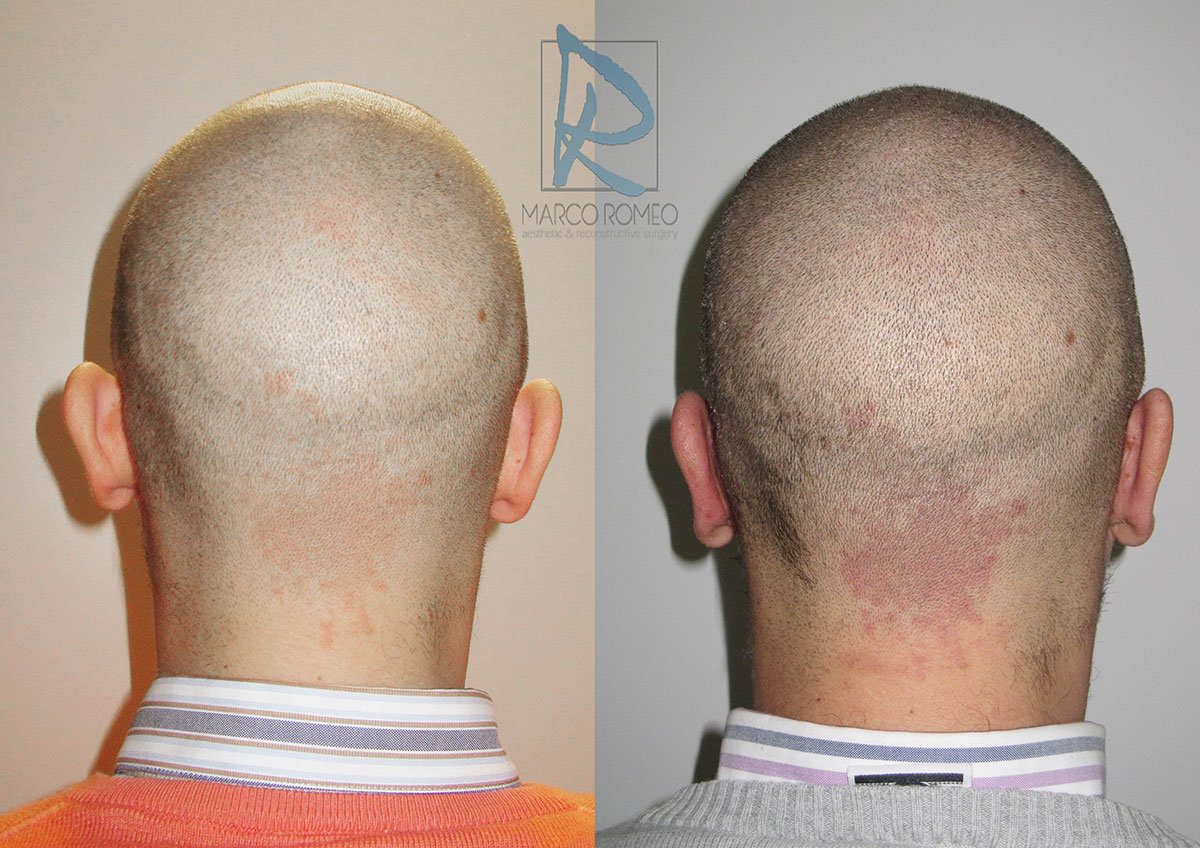
Otoplasty: the operation that brings prominent ears closer to the head. Under an hour, local anaesthesia, hidden scar and a permanent result.
Prominent ears do not hurt and do not affect hearing, but they show in every photo, every haircut and every mirror. Otoplasty is the operation that brings them closer to the head and gives them the fold they lack. It is one of the most rewarding procedures I perform: it takes less than an hour, it is done under local anaesthesia, the scar is hidden behind the ear and the change is permanent.
What otoplasty corrects
The ear normally sits a few millimetres from the head. When it separates more than that during growth, or when the antihelical fold never forms and the ear stays flat, the ear looks prominent. As a rule of thumb, an ear looks prominent when it sits more than two centimetres from the head or forms an angle of more than 25 degrees with it, although in practice how it looks matters more than what it measures.
With otoplasty I correct:
- Prominent or “bat” ears, on one side or both.
- Asymmetry, when one ear sticks out more than the other.
- Large ears, by reducing their size.
- The earlobe, when it also protrudes or is elongated.
Not all prominent ears are the same. Some are pushed out by the concha, which drives the whole ear away from the head; others lack the antihelical fold; many have both problems. That assessment, at the first consultation, is what decides the technique.
Who I operate on
Adults. Any age. Adult cartilage is stiffer than a child’s, which changes the technique slightly, not the result. The two cases I have published in the gallery are 24 and 34 years old.
Children and teenagers. Otoplasty is one of the few purely cosmetic operations I do perform on minors, sometimes before adolescence, because the ears finish growing very early and because the problem is specific, visible and solvable.
But I do not operate on any child at the parents’ request if the child does not ask for it or does not mind. When there are doubts, theirs, the family’s or mine, I do not push: I prefer to see them again in a few months or the following year and operate when the problem persists. And if what they describe is a vague unhappiness with their appearance rather than a specific problem with their ears, surgery waits until a psychologist has seen them. When the complaint is focused and the operation goes well, the improvement in the child’s confidence is one of the clearest I see in consultation.
In younger children the operation is done under general anaesthesia; from a certain age, and always in adults, under local anaesthesia with sedation.
How I perform otoplasty
The incision goes in the crease behind the ear, where it cannot be seen. Through it I expose the cartilage, sculpt it and fold it back to create or reinforce the missing fold, and I fix the new shape with permanent internal stitches. If the concha is what pushes the ear outwards, I add stitches that anchor it closer to the head (Mustardé technique). When there is asymmetry, I work each side with a different tension until the distance to the head is the same on both.
I prefer techniques that shape the cartilage with sutures over those that cut it or weaken it excessively. Cutting is faster and more definitive, but it leaves edges and folds that look artificial and cannot be fixed afterwards. Shaping respects the anatomy and, if in any case the correction falls short, it can be adjusted with a simple touch-up.
The operation is done under local anaesthesia, with or without sedation depending on the patient, and takes less than an hour. During surgery the patient helps by turning their head from side to side. At the end I fit a compressive elastic band and the patient goes home the same day.
The scar
It sits in the groove behind the ear, between the ear and the head, and within a few weeks it is a fine line that is only visible if you look for it. With suture techniques there is no scar on the front. In the two gallery cases you can see where it sits at three and four months.
Recovery day by day
- The same day. Discharge with a compressive elastic band (headband style) around the head. A feeling of tightness and some discomfort, manageable with ordinary painkillers.
- The first few days. It is normal for the ears to be swollen, slightly bruised and more sensitive. Sleep on your back with your head slightly raised.
- The first week. Check-up at the clinic. The stitches are absorbable and do not need removing. You can go back to work or school at around one week, wearing the band.
- Four weeks. The compression band is worn for four weeks: day and night for the first two, then only for sleeping. No contact sports and nothing that could bend the ear. Glasses with care during the first days. Check-up at one month.
- Two months. The swelling has gone and the result is final. The result photos in the gallery were taken between three and four months.
Risks and complications
All surgery carries risks and otoplasty is no exception, although serious complications are rare. The ones I watch for are four. A haematoma in the first days, which the elastic band prevents and which resolves quickly if it appears. A thickened scar behind the ear, more likely in people with a history of hypertrophic or keloid scars, which is why I always ask before operating. Asymmetry, because each ear heals at its own pace and occasionally a small touch-up is needed. And the one I most want to avoid: an ear pinned too close or with a sharp fold, which is what looks operated and is the hardest to undo. That is why I prefer to stop a step short and touch up if needed, rather than overcorrect, because there is no going back.
As with any operation there can also be infection, bleeding, temporary changes in the sensitivity of the skin of the ear, or a reaction to the anaesthesia. We go through all of this in consultation before deciding.
Otoplasty cost
Otoplasty costs between €3,500 and €5,000. What moves the price from one case to another: whether one ear or both are corrected; whether only the antihelix needs treating or also the concha and the lobe; the type of anaesthesia, because a young child needs general anaesthesia and a hospital operating theatre; and whether it is combined with another operation in the same session.
At the first consultation the quote is fixed and includes the surgery, the anaesthesia, the operating theatre and all follow-up visits until discharge. You can compare it with my other procedures in my plastic surgery price guide.
Otoplasty combined with other surgery
Otoplasty can be done on its own or in the same session as another facial procedure. I have combined it with facelift and blepharoplasty in the same operation, and also with rhinoplasty, which is the combination I am asked about most, because both change the profile and recover at the same time.
Before and after cases
The otoplasty gallery has real cases with photos at three and four months, with the technique and anaesthesia of each one:
Frequently asked questions about otoplasty
At what age can a child have otoplasty?
The ears reach almost their final size at four or five, so technically it can be done from then on. In practice I decide case by case with the family and the child; what matters is that the child wants it, not only the parents.
Does it hurt?
Not the surgery, because it is done under local anaesthesia. Afterwards there is tightness and discomfort for the first few days, controlled with ordinary painkillers. The most uncomfortable part is usually sleeping on your back.
Can you tell someone has had otoplasty?
Not if the correction is just right. The aim is an ear that looks as if it had always been there, not a pinned ear. That is why I avoid overcorrecting.
Does otoplasty affect hearing?
No. It works only on the cartilage of the outer ear, not on the ear canal or on hearing.
When can I play sport?
Light sport at two weeks; contact sports or anything with a risk of a blow to the ear, from one month.
Is there otoplasty without surgery?
There are devices and threads that bend the cartilage without an operating theatre. They are quick, but the risk of the ear returning to its original position is high. In newborns, and only in the first weeks of life, moulding with splints does work because the cartilage is still soft.
Where does Dr. Marco Romeo operate?
Consultations in Madrid and surgery at Hospital Universitario HLA Moncloa and Hospital Vithas Aravaca.
Book your consultation
At the first consultation I look at your ears, tell you which technique they need, how long recovery will take and what it costs, with a fixed quote.