
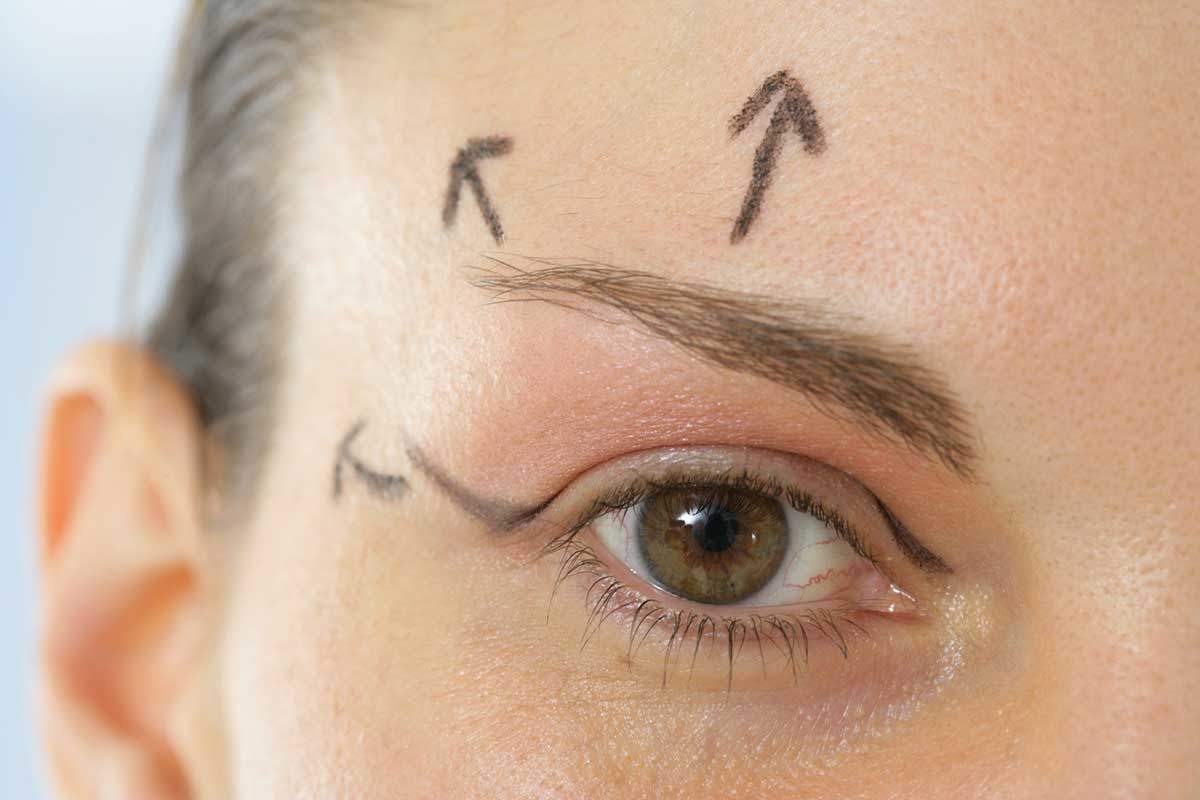
Blepharoplasty: the operation that takes the weight off the upper eyelid and the bags off the lower one. Under an hour, sedation with local anaesthesia and a result measured in decades.
The eyes are the first thing anyone looks at in a face, and the first thing that gives away tiredness. When the upper eyelid becomes heavy and the bags under the lower lid no longer disappear with a good night’s sleep, the whole face looks sad even when you are not. Blepharoplasty corrects that. It is one of the operations I most enjoy performing: it is virtually painless, recovery is short and undemanding, and the benefit, both aesthetic and functional, is enormous. Few procedures give so much in return for so little.
What blepharoplasty corrects
- Excess skin on the upper eyelid, which gives a tired look and, as it progresses, falls over the lashes, gets in the way of applying make-up and can even narrow the field of vision.
- The pockets of fat in the lower eyelid.
- The hollow tear trough, the groove running from the inner corner of the eye towards the cheekbone.
- A lax lower eyelid, which no longer protects the eye properly and causes watering or dryness.
- Ptosis, when one eyelid droops more than the other.
- The shape of the eye, when a more lifted or more almond-shaped look is wanted.
Drooping eyelids come with age, but heredity, weight changes and skin laxity bring them too. For most people it is purely aesthetic; for some, it has already become a problem with their sight.
How I perform blepharoplasty
Blepharoplasty has two parts, upper and lower, and it is called complete when I do both in the same operation.
Upper eyelid. I always use the transcutaneous approach, that is, removing the excess skin. The incision sits in the natural crease of the eyelid, where it stays hidden. In the same movement I remove the portion of fat that shows at the inner corner of the eye. Occasionally the opposite is needed: when the eye is very hollow, instead of removing fat I add it.
Lower eyelid. Here the approach changes. In most cases I work transconjunctivally: I enter from inside the eyelid, through the conjunctiva, and no external scar is left. Only when there is excess skin do I open from the outside, along the lash line, and in that case I almost always add a canthopexy. The usual step in the lower eyelid is to remove the accumulations of fat that form the bags. But very often I do not remove all of it: I take part away and turn the rest downwards to fill the tear trough, what everyone calls the dark hollow under the eye. In a single procedure I reduce the bags and correct the hollow.
Canthopexy. This means lifting the canthus, the outer corner of the eye. I do it when the eyelid has dropped with age and the tissues have slackened, or when the patient wants a more lifted, more almond-shaped look, the so-called “foxy eye”: by pulling the eyelid laterally, the eye takes on a more elegant shape.
Ptosis. If one eyelid droops more than the other, I assess whether there is weakness of the levator muscle of the eyelid. In that case I operate on Müller’s muscle or on the levator to correct the droop and level up both eyes. Here too I prefer the transconjunctival approach, so as to leave no scar.
Crow’s feet. These can be reduced with a small incision in the orbicularis muscle, which then loses strength and stops etching the lines. I almost always prefer to control them with botulinum toxin, because it is anatomically safer and does not compromise the result.
Who I operate on, and when I wait
I operate on healthy adults with excess eyelid skin, bags, or both, and with realistic expectations: blepharoplasty rejuvenates the gaze, it does not change the face. Before deciding I need to know about any allergies affecting the eyes, glaucoma, diabetes, thyroid problems or contact lens use.
There are two things that make me wait. If the patient has hyaluronic acid in the area, I need to know and take it into account. And if they have had botulinum toxin in recent months, its effect has to wear off before surgery: operating with the neuromodulator still active increases the risk of complications.
Anaesthesia and duration
An upper or lower blepharoplasty takes less than an hour. A complete blepharoplasty with canthopexy, a little over an hour.
It can be done under local anaesthesia, and that is how I do it when the patient asks, because they want to be awake, because general anaesthesia frightens them or because they cannot have it. But in most cases, to make the experience easier and more comfortable, I use sedation with local anaesthesia: the patient is unaware of the procedure, recovers quickly and goes home the same day, with no ward stay and no night in hospital.
Recovery day by day
- The same day. Discharge with cold compresses for a couple of hours to reduce swelling. Eye ointment and drops. Sleep with the head raised.
- First week. This is the week of swelling and bruising, which clear up on their own. The stitches in the upper eyelid come out after five days. Sunglasses outdoors and no make-up over the incisions. In most cases the patient is independent from day one; in those who swell rather more than usual, vision can be uncomfortable for a few days and I advise against driving or reading much. That is why I ask patients to set the first week aside: a few days off work with a quiet social life. It is rare to need them, but it is worth having them.
- Between the first and second week. Back to work, to make-up and to exercise. With more swelling, that stretches to ten or twelve days.
- At one month. The result is already visible and there to enjoy. As with any surgery, the final appearance settles over the course of a year.
The result of blepharoplasty is very stable and among the longest-lasting in facial surgery: it is measured in decades.
Risks and complications
Patients need to know that complications are possible, even if they are uncommon. There are four I watch for. Haematoma, prevented with the cold compresses and rest in the first few days. Postoperative conjunctivitis, which appears from time to time and settles on its own or with drops and protection of the eye. Lagophthalmos, a loss of tension in the lower eyelid that stops the eye from closing fully; it is corrected with a canthopexy. And asymmetry, which is rare and is almost always prevented in the planning of the surgery itself.
As with any operation, infection, bleeding or temporary changes in sensation can also occur. We discuss all of this in the consultation before deciding.
The price of blepharoplasty
Blepharoplasty costs between €2,500 and €4,000. What moves the price within that range is, first, whether only the upper eyelid, only the lower or both are operated on; second, whether a canthopexy is added; third, whether it is done under local anaesthesia or with sedation and general anaesthesia. And, separately, whether lipofilling or a brow lift needs to be added, which may call for an endoscopic lift of the tail of the brow.
At the first consultation the quote is fixed. You can compare it with the rest of my procedures in my plastic surgery price guide.
Blepharoplasty combined with other surgery
Blepharoplasty is performed on its own or in the same session as another facial operation. The combination I recommend most is with a facelift: the eye area carries more weight than any other in how rested and how young a face looks, and when both are treated at once the result is multiplied. I also combine it with a brow lift, with lipofilling and, in patients who want to harmonise the whole face, with ultrasonic rhinoplasty or otoplasty.
For a hollow tear trough with no excess skin and no bags there is a non-surgical alternative, hyaluronic acid, which lasts between six months and a year.
Before and after cases
The blepharoplasty gallery has twelve real cases, with the technique, the anaesthesia and the recovery time for each one, and photographs taken between six weeks and six months. Some examples:
- Woman of 45, complete blepharoplasty: the lower eyelid approached transconjunctivally, with no scar.
- Woman of 59, upper blepharoplasty with correction of a congenital ptosis of the right eye.
- Patient of 61, complete blepharoplasty with an incision in the orbicularis muscle for the crow’s feet.
- Upper and lower blepharoplasty with canthopexy to lift the gaze.
- Young patient with unilateral ptosis, corrected to level up both eyelids.
Frequently asked questions about blepharoplasty
Does blepharoplasty hurt?
Virtually not at all. The surgery is done under local anaesthesia, with or without sedation, and afterwards there is tightness and swelling rather than pain. It is one of the facial operations with the least discomfort.
Will the scar show?
In the upper eyelid it sits in the natural crease and disappears from view within a few weeks. In the lower lid, if I go in from inside the eyelid, there is no scar; if it has to be opened from the outside, it sits along the lash line.
How long does the result last?
Decades. It is one of the operations with the longest-lasting benefit. The skin goes on ageing, but the bags do not come back.
Can I have surgery if I use Botox?
Yes, but not while it is active. You have to wait for the effect to wear off, usually a few months, before surgery.
What is the foxy eye?
A more lifted, more almond-shaped look, achieved by pulling on the outer corner of the eye with a canthopexy. It can be done within a blepharoplasty or on its own.
Can the tear trough be treated without surgery?
If the problem is only the hollowing, yes, with hyaluronic acid. If there are bags or excess skin, the answer is a lower blepharoplasty, which can also use the patient’s own fat to fill the hollow.
Where does Dr Marco Romeo operate?
Consultation in Madrid and theatre at Hospital Universitario HLA Moncloa and Hospital Vithas Aravaca.
Book your consultation
At the first consultation I look at your eyelids, tell you what they need, upper, lower or both, with or without a canthopexy, how your recovery will go and what it costs, with a fixed quote.