
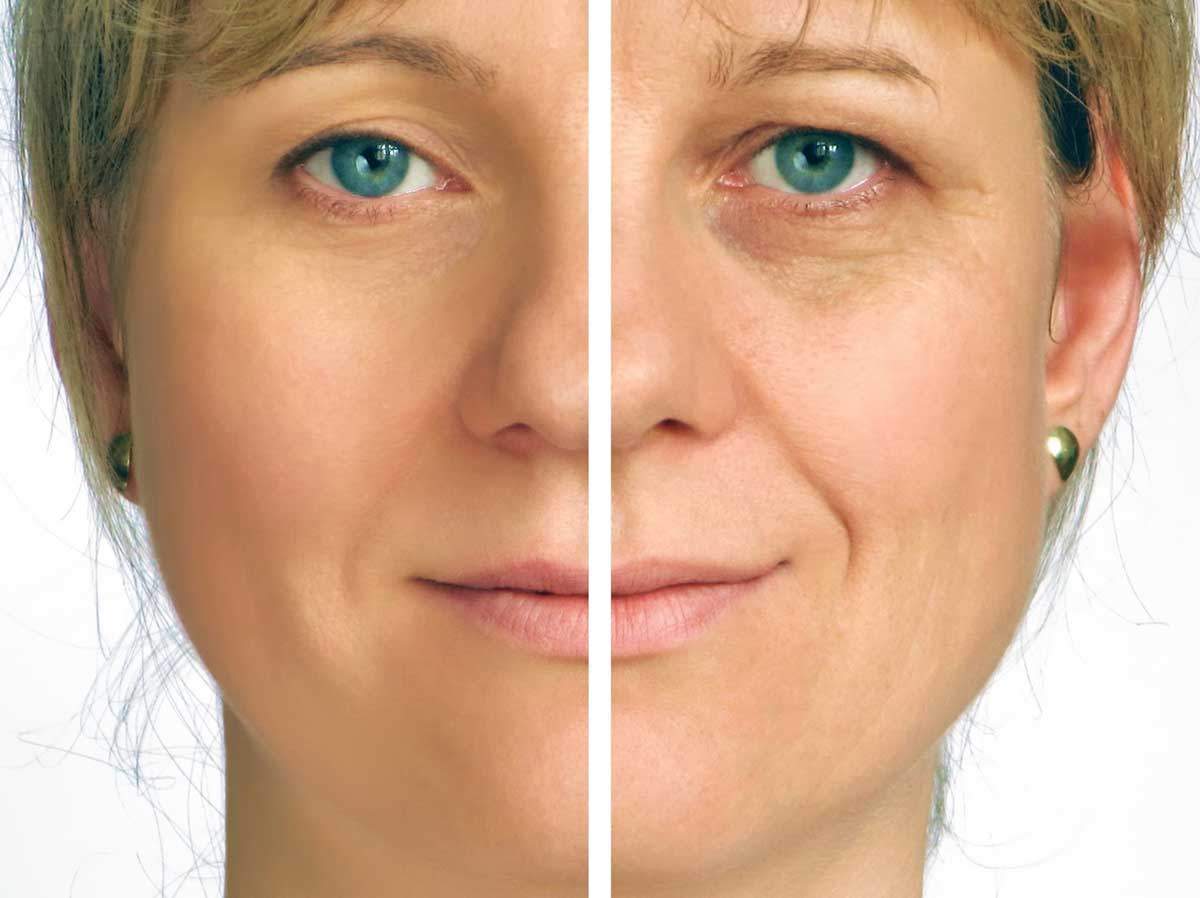
“People should notice that you look well, not that you have had surgery.”
What is a facelift
A facelift is a face lift or, more precisely, a face and neck lift: the surgery that corrects sagging of the face and neck by returning the structures that have descended with age, the muscles, fat and ligaments that support the face, to their original position, and removing the excess skin. The medical term is rhytidectomy. It treats the middle and lower thirds of the face, from the cheekbones down, and the neck, and it is the only way to recover a defined jawline once the sagging is structural. It can be combined with a lift of the upper third, the temporal brow lift, which I perform endoscopically.
When someone comes to my practice thinking about a facelift, they almost never tell me they want to look younger. They tell me they are afraid of looking artificial. It is the same fear that has accompanied this operation for decades, and it has an explanation: old facelifts pulled on the skin, and pulled skin shows.
Today I work the other way round. My job is to reposition the structure and let the skin follow, without tension. That is why your expression is preserved, your smile is still yours and nobody asks what you have had done.
I am a plastic, aesthetic and reconstructive surgeon specialising in facial surgery, and I operate in Madrid.
| Anaesthesia | General. |
|---|---|
| Duration | 3 to 5 hours. |
| Hospital stay | Home the same day or one night, depending on the extent. |
| Back to work | 15 days. |
| Result | Visible at one month, final between 6 and 12 months; lasts 10 to 15 years. |
| Price | From €13,000 to €22,000. |
| Where | Madrid, at HLA Moncloa and Vithas Aravaca hospitals. |
What a facelift corrects
What it improves is specific:
- Sagging cheeks and loss of cheekbone definition.
- The nasolabial folds, between the nose and the mouth, and the marionette lines, from the mouth down to the chin, once they are deep.
- Jowls and the jawline, the first thing that gives away age.
- Loose neck skin, with or without the vertical bands that show when you tense it.
What it does not do: it does not improve skin quality or pigmentation, it does not give you a different face and it does not stop ageing. You keep getting older, just from a better starting point. For fine texture and uneven skin tone, it can be combined with a CO2 laser in the same operation.
When it makes sense to have surgery
There is no right age. What matters is the tissue, not the date of birth. Most of my facelift patients are 45 or 50 and over, but I have operated safely on people in their seventies in good health, and also on younger patients whose genetics give them a wide neck or features that have made their face look heavy since they were young; there the facelift does not rejuvenate, it harmonises.
What I do see often is the opposite of what people fear. The problem is not having surgery too early, it is having it too late: stringing together small treatments for years when the loss is already structural, spending more than the surgery would have cost, and arriving in the operating theatre with less room to achieve a natural result.
The moment usually comes when hyaluronic acid, thread lifts or biostimulators, injectables that activate collagen, start to wear off quickly or to stop being worth it. They improve wrinkles and restore volume, but they neither remove skin nor reposition anything.
Which technique I use in each case
Depending on the case, I choose the most appropriate plan. Today I work with two techniques and their combination:
- Deep plane face and neck lift. I operate in the deep plane, beneath the layer of muscle and firm tissue that supports the face: I release the ligaments and move muscle, fat and skin as a single unit, as a block. When neck laxity is the main issue, I extend the same principle to the neck and its muscle, the platysma, the thin sheet that runs from the jaw to the collarbones. It is the technique I explain in full on its own page, the deep plane facelift.
- Endoscopic lift. For the upper part of the face, brow and forehead, with a tiny camera through minimal incisions hidden in the hair. And when there is not much excess skin, or in bald men, a fully endoscopic facelift can be performed, with no visible scars.
- The combination of both, to treat the whole face, from forehead to neck.
What the surgery is like
The operation takes between three and five hours, depending on its extent and on whether I combine it with other procedures.
I perform it under general anaesthesia. The incisions are hidden in the hairline and around the ear, following the natural creases, so that once healed they are barely visible. I lift the skin, reposition the deep tissues and remove the excess skin without leaving it under tension.
On closing I use a haemostatic mesh, a material that helps seal the small vessels and the spaces beneath the skin, so no drains are needed and the risk of haematoma drops almost to zero.
Recovery, day by day
- First 48 to 72 hours. Swelling and some bruising, a feeling of tightness and discomfort that is controlled with painkillers. Rest with your head elevated and apply cold.
- First week. The swelling starts to go down and applying cold is still useful. Stitches are removed between day five and day ten.
- Two weeks. Most of the swelling and bruising has gone. Most of my patients go back to work at 15 days, and make-up helps bring social life forward. The scars are concealed by the hairstyle.
- First month. You can go back to exercise.
- Following months. The result settles. It is normal to notice numb areas on the face or ears for weeks or months; sensation returns.
While you heal I ask for sun protection and sunglasses, and to avoid saunas, swimming pools and direct sun exposure.
Risks and complications
A facelift is major surgery and, like all surgery, it carries risks. I prefer to explain them before rather than after.
The most frequent complication in a facelift is a haematoma, a collection of blood under the skin in the first hours. It occurs in a small percentage of patients and, if significant, it is evacuated in the operating theatre without further consequences. It is the reason I control blood pressure before and after surgery. In practice, thanks to the haemostatic mesh, today the risk of haematoma is virtually zero.
What worries people most when they ask is injury to a branch of the facial nerve, the one that moves the muscles of expression. It is worth putting numbers to it: a meta-analysis, a study that pools the results of many others, published in Aesthetic Surgery Journal with more than 41,000 patients found a rate of temporary nerve weakness below 1 % in the techniques that work beneath the supporting layer, the same as in the more superficial ones, and in every case it resolved on its own. Permanent injury is exceptional. In my case, my academic training in facial nerve reconstructive surgery and the blunt dissection technique, separating the tissues without cutting, make nerve handling especially safe.
Less frequently, the following can also occur: infection, fluid collection, scars that widen or thicken, hair loss around the incision, changes in sensation, asymmetries that require a touch-up and the risks inherent to anaesthesia.
Some factors multiply them, and those are in your hands: tobacco above all, because it compromises healing and the skin, poorly controlled high blood pressure and medicines that increase bleeding. I ask you to stop smoking two to four weeks before surgery, and to stop semaglutide (Ozempic, Wegovy and similar) before the operation.
How long the results last
Because it acts on the structure and not on the skin, the result is stable. The reference I work with is ten to fifteen years, with the difference that from then on you age from a better starting point and more gradually.
What influences it most afterwards is the usual: sun, tobacco, sudden weight changes and skin care. Rapid weight loss, above 10 to 15 % of body weight, empties the fat pads that give the face its volume and can undo part of what was gained.
What is often combined with it
A facelift does not always come alone. The most common additions are blepharoplasty, or eyelid surgery, because the eyes give away as much as the jawline, and lipofilling, a graft of your own fat, to restore volume to the cheekbones and temples. When the profile also calls for chin projection, I consider a mentoplasty, chin surgery. Also peels or laser when what is missing is skin quality.
My patients' results
These are three real cases, with their before and after photos, the technique used and the recovery time of each:
- Facelift for men: thin face and sagging skin. A male patient, with the scar hidden and the jawline redefined.
- Face and neck lift: sagging cheeks and jawline.
- Deep plane face and neck lift: jowls and sagging cheeks.
You can see them all in the facelift gallery.
Price of a facelift in Madrid
The price of a facelift in my practice is between €13,000 and €22,000, depending on the type of lift and the treatments combined with it.
The price includes the consultation and surgical plan, the operating theatre, the medical team and anaesthesia, the facial garment, post-operative care and all the follow-up visits during the first year. Financing is available.
At the first consultation you get a fixed quote. You can compare with the rest of the procedures in my plastic surgery price guide.

Frequently asked questions about facelifts
How long does a facelift last?
The surgery, between three and five hours. The result, ten to fifteen years: it does not stop ageing, but you age from a better starting point.
Is there such a thing as a facelift without surgery?
Not with the same result. Thread lifts, focused ultrasound and collagen-stimulating injectables improve skin firmness and buy time, and I use them when the sagging is mild. But none of them repositions the structures or removes the excess skin: once the sagging is structural, only surgery corrects it.
Mini facelift or full facelift?
“Mini facelift” is an incorrect term that should not be used: there are no small and large facelifts, there are areas to treat. We talk about a facelift, a neck lift and an upper third lift, brow and forehead, and about which ones each face needs. The examination decides, not the age.
Is it too late for a facelift at 60 or 70?
No, if you are in good health. I operate safely on patients in their seventies; what matters is tissue quality and general condition, not the number. What does compromise the result is waiting until the sagging is extreme.
What is the difference between a facelift and a deep plane facelift?
The deep plane is itself a type of facelift: the one that works beneath the supporting layer of the face, releasing the ligaments and moving muscle, fat and skin as a single unit. It is the most complete option for the midface and the neck, and I explain it in detail on its page.
Is the post-operative period painful?
Less than people imagine. Pain is anecdotal and bruising is scarce. What you notice most is the tightness and swelling of the first few days.
Where do you operate?
In Madrid, at HLA Moncloa Hospital and Vithas Aravaca Hospital, the same hospitals where I perform the rest of my facial surgery.
Are you thinking about a facelift?
If you feel your face no longer reflects how you feel inside, the first step is a personalised assessment in Madrid: looking at your anatomy and the condition of your skin, and deciding which technique is right for you.